Category Archives: Off the (Gardening) Wall

GBMD: Woodchucks

Garden Blogger’s Muse Day, updated again

This one is for GardenJoy4Me and everyone else out there battling woodchucks and racoons and other critters. Not that I am recommending this method, but it’s long been a favorite poem of mine, and came to mind as I read of several decimated gardens and the ongoing struggle to remove the decimaters humanely.

Woodchucks

Gassing the woodchucks didn’t turn out right.
The knockout bomb from the Feed and Grain Exchange
was featured as merciful, quick at the bone
and the case we had against them was airtight,
both exits shoehorned shut with puddingstone,
but they had a sub-sub-basement out of range.

Next morning they turned up again, no worse
for the cyanide than we for our cigarettes
and state-store Scotch, all of us up to scratch.
They brought down the marigolds as a matter of course
and then took over the vegetable patch
nipping the broccoli shoots, beheading the carrots.

The food from our mouths, I said, righteously thrilling
to the feel of the .22, the bullets’ neat noses.
I, a lapsed pacifist fallen from grace
puffed with Darwinian pieties for killing,
now drew a bead on the little woodchuck’s face.
He died down in the everbearing roses.

Ten minutes later I dropped the mother.  She
flipflopped in the air and fell, her needle teeth
still hooked in a leaf of early Swiss chard.
Another baby next. O one-two-three
the murderer inside me rose up hard,
the hawkeye killer came on stage forthwith.

There’s one chuck left. Old wily fellow, he keeps
me cocked and ready day after day after day.
All night I hunt his humped-up form. I dream
I sight along the barrel in my sleep.
If only they’d all consented to die unseen
gassed underground the quiet Nazi way.

–Maxine Kumin

While hunting for this poem on-line I discovered that there’s a fair amount of really bad analysis of it out there. Don’t read any of it.

Rather to my surprise, this poem upset and angered a fair number of students, I discovered. (This was in a poetry course with a full range of college students in it.) That response always surprised me, but then it always seemed to me that the poem contained a critique of the action it describes, so that the poem’s subject isn’t shooting the woodchucks, but the moral quandry this action inspired. How privileged, this literary remove from life.

By the way, after perusing the serious submissions out there, zip on over to the Bumblebee blog for a swift lightener-upper.

UPDATE:

Here’s a link to Kumin reading the poem. The most interesting part, for me, is her brief introduction, in which she says this is "a terribly autobiographical poem." 
Done at last–

At about three a.m. on Friday morning, I mailed my one hundred and thirty-two-page opus, the lawn-care article, off into the world and entered upon a new phase of life: the post-organic-lawn-care-article phase. I feel dazed.

When we were children, my sisters and I each had a special adult. Mine was Shifra, and she gave me two gifts, aside from the intangibles. One was The Bat Poet, one of those odd, unlikely, perfect books, which I have loved my whole life but whose author I had to look up for this post: Randall Jarrell, the poet, with pictures by Maurice Sendak. No wonder it is so beautifully crafted, a gift to the world.

Near the end of the book it is autumn, and the bat’s squirrel friend is so busy carrying nuts to his hole that he can’t stop to talk or to listen to the bat’s poems. Then one day when he reports in a dazed voice, “It’s full. My hole’s all full.”

That’s how I feel at the moment.

Continue reading

Chard Gone Wild = Garden Omelet

When I got up this morning, everything was different. No water falling from the sky; no rain. From my bedroom window I could see the mountains over my neighbor’s roof.  No fog, no low clouds.

Downstairs, there was a weird brightness to the world. I had to squint to see, and when I looked up, I couldn’t see at all. What was–wait, I remember–it’s–it’s–it’s sunshine! Yes, the sun was shining. I would get into the garden today.

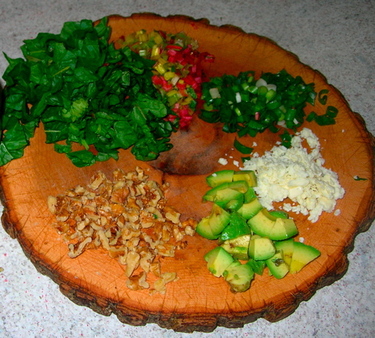
So I made an omelet for the Significant Other and myself. (If you cannot follow the reasoning here, go away.)

Omlette_ingredients_6

Continue reading

What’s for lunch? Dandelion Salad

I admit it; I share the usual North-American prejudice against dandelions. But both the weather and I are so seriously behind this year that I’ve started adding dandelion leaves from my weeding excursions to the few spinach, lettuce, mustard, and chard leaves big enough to cull.

After all, the things are chock full of good stuff: vitamins A and C, plus iron (more than in spinach), phosphorus, and calcium.

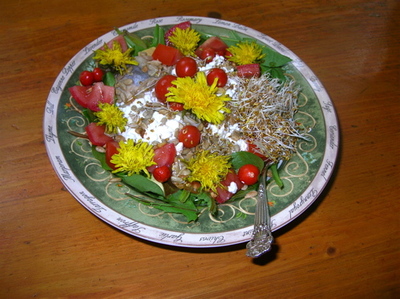
I wasn’t at all sure that the various sons and husbands on the premises would tolerate this addition, but there have been no complaints, and the salad has been disappearing at quite a clip. Today I took the next step: I added the flowers to my salad. They, too, have vitamins A and C. Here’s the result:

Dandelion_salad

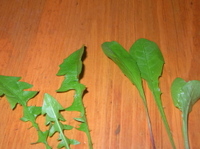
Several years ago I noticed there seemed to be two different sorts of dandelion around, one with its familiar, deeply lobed leaves, Dandelion_2_kinds_3 and one with much shallower indentations. The second seemed far more palatable–lighter, less bitter, more tender– than leaves of the one, the true, the original dandelion. I prefer the interloper for both texture and flavor.

But I began to wonder if I was poisoning my family (heavy metals yesterday, toxic greens today–as son #2 says, That’s how we roll–) so this afternoon before lunch I spent some time on the Web, with the result that I am now thoroughly confused. In summary: there are two different plants–false dandelion (Hypochoeris radicata), and fall dandelion (Leontodon autumnalis)–that might be mistaken for the common dandelion, but sources disagree about which has shiny leaves and which hairy, and almost no source covers both.

I can’t say, then, what precisely I’m eating, which is not good. However, a number of sources did state that none of the close look-alikes are poisonous, and that’s good. So I went ahead and ate my salad.

Which was delicious.

Palimpsest: spring poem

I have been inspired. I’m going to start including poetry here. Nancy Bond can do it; so can I.

Nancy Bond, a writer poet photographer in Nova Scotia (where I spent a month the summer I was sixteen–Oh!) boldly puts the word "poetry" into the heading of her blog Soliloquy which I encountered on Blotanical, a forum for blogging gardeners, and the first post I saw on her second blog, All Nature, My Garden, began with a Robert Frost poem. So as I say, she inspired me to include poems from time to time, including some of my own. Here’s one that I’ve got to include soon or not at all this year.

A palimpsest, by the way, is a piece of parchment that’s been used numerous times–written on, scraped, written on, scraped–but never, probably, scraped quite clean (just as it’s almost impossible to erase pencil completely) so that traces of the earlier writings remain, and the parchment becomes a layered history of its many messages.


Palimpsest

Spring’s first smell’s the smell of rot,
last fall’s unfinished business
done, quick, before the grass grows.
No: not death first, then life, in orderly progression;
leaf to soil, soil for seed, now all together, sprout!
This slate’s never wiped quite clean.
Whose obsession is that?

It’s grass itself, and fungi, that finish autumn off.
Those first pale greens
spear the dead damp hearts
of blackened leaves and lift them skyward,
an inch or two.

Tut, Nature, tut;
this is how they told us
nothing would get done.

–Kate Gardner
theManicGardener

In the interests of full disclosure, I’ll mention that this was published eons ago in The Hamline Review: A Faculty Annual (V.20, spring 1996). I doubt they’ll ever know, or care, and I don’t think they’re in the business of running around pursuing copywrite privileges, but there it is. (It’s not as though this poem is a major money-maker for them or for me, more’s the pity.)