
Author Archives: The Manic Gardener

This Cold House: Chard for Organic Indoor Gardening Any Sixty Degree-Day

As mentioned a few week ago, the tomatoes I brought indoors last autumn haven’t exactly thrived. They are still, by most definitions, alive, but the aphid population is doing better than the tomatoes.Chard_2_indoor_4
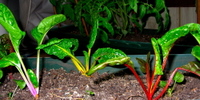
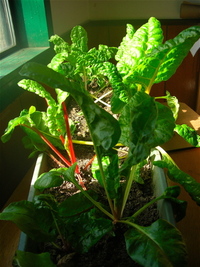
The chard, however, is thriving. At the end of fall I crowded six or seven tiny plants into a two-foot long planter and gave them the best spot I could. The room is unheated, but the window is sunny, so temperatures in winter range from sixty odd by day to thirties at night.  The plants haven’t burgeoned, but they’ve grown, and seem happy. The left-hand photo was taken December 18th; that on the right twelve weeks later, on March 9th.Beautiful_chard_2
Chard is a cold-weather crop, better suited than tomatoes to conditions in this cold-weather climate and this cold house.  It’s also a lot less vulnerable to infestation and disease than tomatoes. The main problem I’ve had with chard here in Montana has been the same I’ve had with spinach and broccoli: leaf-miners, and those I seem not to have imported along with the plants.

There was a slight setback when one of our cats got locked into the room with the chard and uprooted half of it in a desperate search for a cat toilet, but most of the plants seem to have made an excellent recovery from that unfortunate event.

I love these multi-colored stems; they make traditional white chard seem washed-out, bleached, in comparison. When I brought in a fistful of red-stemmed chard one summer a year or so back, my mother thought they were beet greens.

Next year, I’m going to bring in larger plants, and more of them. Next year I won’t let the cat uproot them. Next year…

For the moment, though, I have chard for miso soup, and for omlettes. It’s as tender as spinach, the stems crisp as celery, but prettier.

Letter from Toronto: The Look of Organic Lawns

written 4/15

If I didn’t know there was a pesticide near-ban in Toronto, I wouldn’t be able to tell from the look of lawns and parks around town. Since my parents still bike everywhere though he’s 81 and she’s "in her eightieth year," as she modestly puts it  (they don’t own a car), I see a lot of lawns and parks up close just biking with them to lunch, or the cheese store, or the lawyer’s, or a friend’s house.

What appears in those lawns and parks, though, isn’t all that revealing, because spring here is weeks behind. When I planned the trip, I figured I’d be able to learn a lot from how the lawns and parks look, even if I didn’t manage any official interviews. After all, it’s April, and though spring is barely a rumor back in Montana, it should be well-advanced here.

Or so my memory of high school springs told me.

After several days here though, I cannot claim to have made great progress. My calls are all suspended in some virtual purgatory, and the weather is not co-operating. When I got up this morning (this was ), it was 34 degrees Fahrenheit here, or barely above zero on the Celsius thermometer used in Canada (and in the rest of the world), and 39 in Bozeman. A few days ago the split was even wider: forty something here for the high and seventy-seven in Bozeman.

(Of course, the temperature in Bozeman is now falling and due to continue doing so; by the time I get home it should be back in the normal range, dang it. Where is justice?)

In Toronto, the trees are bare of leaves, though some appear to be thinking about budding; the lawns are green, but only just. Crocuses are blooming everywhere, and the tiny blue-flowered scylla, and on one ride I spotted daffodils are out on a warm south-facing slope, but no forsythia yet. It’s been a long winter here.

I’d read one blog entry before leaving that said Toronto’s parks look awful; that certainly wasn’t my impression, but the dandelions were barely sprouting, much less flowering. So I can’t say I got a good impression of the parks, but in this context that means not that they look bad, but that I didn’t have a good chance to form an impression. Since my next visit may be in October, I’ll hope that fall this year also comes late. If it comes as early as spring is late, I’ll be looking at fallen leaves and brown grass, or even at snow.

Letter from Toronto: Pesticide Bylaw Not Quite a Ban

I’ve been talking (and writing) about the pesticide “bans” (without quotation marks) in Toronto and other Canadian cities for months now, and just discovered that I don’t know what I’m talking about.

When I decided to visit Toronto to see my parents, I figured it would be great chance to learn more about the impact of the pesticide “ban” passed several years ago. Were people complying? Were there a lot of complaints? How did the parks look? How had the parks department adapted? Was the “ban” successful?

So I called a series of environmental organizations and city parks employees, explaining to each that I wanted to learn more about how things were going since the pesticide “ban.” The third or fourth one interrupted me: It’s not a ban, he said, which brought me to a screeching, stuttering, embarrassed halt.

When I re-read the by-law more carefully after that conversation, I saw the exception I’d missed: that pesticides are permitted “To control or destroy pests which have caused infestation to property.” Herbicides are banned outright, but insecticides are severely limited, not banned.

The city employs an Integrated Pest Management (IPM) approach, meaning that everything is done to encourage healthy plants (including grass) and that pesticides are not used routinely. However, if an infestation does occur and other methods don’t succeed in controlling it, synthetic pesticides can be used.

Many Canadian bylaws contain an exception of this sort, I’ve discovered; some even specify the number of cinch-bugs per tenth of a square meter that constitutes an infestation. Apparently property owners in Toronto must stand ready to explain any use of pesticides, so they need to count and record pest-levels.

Before I could ask any more questions, my informant told me I needed to go through the city’s Media Hotline, a clearance center for all requests to speak to City employees. The Hotline is currently processing my request; I’ll be back to you after they get back to me.

Shop-Vac as Organic Gardening Tool: Suck Up those Cinch Bugs

You heard it here first—

In yesterday’s list of weird things I’ve learned while researching a website on organic lawn care, I mentioned the use of Shop-Vacs against cinch bugs.  Here’s the low-down.

Organic gardeners are used to the idea that household items lead double lives in the garden. Lemon juice, vinegar, salt and sugar are all used against weeds or insects, old sheets protect plants from frost. Now the Shop-Vac too can be pressed into the organic line of duty.

That’s right; you too can join the new suburban craze; take your Shop-Vac out to the front lawn and vacuum up cinch bugs! Where neighbors used to visit over barbeques, now they compare their cinch-bug catches, peering into the bellies of each other’s shop-vacs to see who made today’s big haul.

It’s not here yet, but it may be coming, and when it does, I’m going to go out on my front lawn and cheer. (I won’t join in, because there’s no grass in my front lawn, just pine needles.)

The guy who recommends the method insists that “it works!” He’s David Patriquin, a Professor of Biology at Dalhousie University in Halifax, Nova Scotia, and he’s got an amazing web of web-pages devoted to cinch bug control.

Now, I’d never heard of these awful creatures before starting a writing project on organic lawn care, but apparently they can do a number on grass despite being only 4 mm (a quarter of an inch) long even as adults. While most pests only feed on grass during one phase of their many-staged lives, the cinch bugs devote themselves to it, through all 5 nymph stages and as adults. Fortunately the eggs and the first nymph stage are red, and therefore it’s possible to see them, even though they’re smaller than pinheads.

Patriquin’s page “Facing a Cinch-Bug Problem NOW?”  <http://www.versicolor.ca/lawns/chinchNOW.html>
walks the beleaguered lawn-owner through the diagnostic process, then offers a range of control options, most of which, however, are not yet legal in Canada (or weren’t when the page was last updated). Even insecticidal soaps and Neem are approved only for some pests, cinch bug not included. Why? Apparently this information is being given out only on a need-to-know-basis, and Patriquin doesn’t qualify.

Patriquin reports that the parks director in one small resort town on the Bay of Fundy keeps out an eagle eye for cinch bugs. When he finds a patch, he rakes the surrounding area into the center of the patch and then descends on it, Shop-Vac in hand.

So if you see your neighbor out front this summer with an industrial-sized vacuum cleaner, tackling not her car but her lawn, you may well decide that she’s lost it at last. (And with that husband, it’s a miracle it didn’t happen sooner.) But there’s another possibility: she’s going after cinch bugs.

Weird and irrelevant things I learned on the way to the organic lawn

"The time has come, the Walrus said, to speak of many things—"  I’ll write about the relevant things too, but not this time.

These days I’m writing an article, a website really, on organic lawn care for Planet Natural, which I think of as my little local organic gardening store. That’s a bit (but only a bit) like thinking of the Mayo Clinic as your corner drugstore since Eric Vinje, who runs the place, ships products all over North America and gets interviewed on a semi-regular basis for a lot of "green" stories these days.  And that is the fault of the ladybugs, which is another story.

"Yeah, I just got off the phone with this guy from –" what was it this time, the Washington Post? I forget. If he’s looking for sympathy, he’s looking in the wrong place. He may be Mr. Rising Star of the organic gardening, but we’re a ways yet from a point at which I have to call him "sir" or he has to tuck in his shirt.

So like I said, I’m writing this article, and the most amazing stuff drifts across my computer screen. It’s one of the fringe benefits of the research-and-write job: there’s all the information you learn about the actual topic, but there’s all this other stuff too, the odd facts that come zinging in at an acute angle to the story as I understand it, go whang into the center of the piece and stick there, quivering.

Here’s a sample:

There are over 200 public lawn bowling greens in present-day Glasgow.

The Levitts, who built some of the early cookie-cutter suburban developments in the US, (including the first Levittown, on Long Island) didn’t believe in basements (they pioneered cement-slab houses), but they set up a little newspaper for each development.

–The first North American golf courses were built in Canada.

–Up to 50% of homeowners who use pesticides don’t read the labels or follow the directions.

–Clover used to be considered a desirable part of upscale lawns.

–Almost none of the turfgrasses available in North America are native to the continent.

–Lawn bowling or one of its close cousins is five to seven thousand years old.

–The pesticide Mancozeb is marketed under at least fifteen other names.

–Almost everything Americans (Canadians too, probably) did to care for their lawns in the 50s encouraged crab grass.

–A hundred and thirty-eight Canadian towns and cities (including 2 million-strong Toronto) and one entire province (Quebec) have banned the cosmetic use of all synthetic pesticides.

–Switzerland banned 2,4D in 1988.

–You can vacuum up cinch bugs from a lawn, and at least one parks director in Nova Scotia does so regularly.

–In parts of Canada, pyrithium is legal against certain pests, but insecticidal soap and NEEM are not. Go figure.