Author Archives: The Manic Gardener

Time’s winged chariot drawing near

More than one poet has bemoaned the quick passage of time, and more than one gardener has observed that it is not only lovers who have reason to join in that plaint. Just this weekend, another blogger at Hoe and Shovel titled a post,  "The Garden Waits for No Man," to which I can only say, Right on, dude.

So, having been away two weeks of the past four (as anyone who’s been reading here already knows), I am BEHIND. This weekend, I vowed to catch at least part of the way up. (Now, if that’s not an awkward phrase, I don’t know what is. Oh yes, I do. Ask, and I might tell. Anyone else out there have a favorite awkward phrase?)

I’d prepped some of the beds last fall, but not all. On Saturday, between having my mother-in-law to brunch, Alley_plot_in_rain2_3 going to a party for a friend who just earned her MA in plant pathology (more on that later), and an evening movie with another friend (whose parents, horror of horrors, have never seen Star Wars, so she and her husband are rectifying that wrong), I somehow managed to dig amendments into one four-by-four plot and even get potatoes planted.  When they sprout, I’ll push the soil around those little hollows over them.

Sunday was not so easy. Sunday I tackled the worst of the worst, the heaviest, most densely packed, least yielding, ugliest, meanest plot of them all. It took me four hours. As I left the house in my rain jacket to get started, I glanced at the grey clouds and said to my son, "When do you think it’s going to start raining?"

"It’s not going to rain."

"Ah, you’re wrong there, J., because it surely will someday."

About fifteen minutes after I went out, I felt the first drops. An hour later, I was wheeling a barrow full of horrible clayey earth towards a dumping spot and passed J., lifting weights in the yard.

"Not gonna rain, huh?"

"It’s not raining!" he cried, face dripping. "Call this rain? This isn’t rain."Alley_plot_2_2

"Huh." I struggled on, not having breath for more.

I suspect even he would have conceded that it was raining, had he stayed out as long as I did. When I finally raked the top-soil smooth, put my tools away and staggered inside, my shoes were so muddy I didn’t want to defile even our porch with them, but left them outside, and my toes were so cold they stayed purple and white until nearly the end of my bath.

But the alley plots were ready plant.
Spring has sprung?

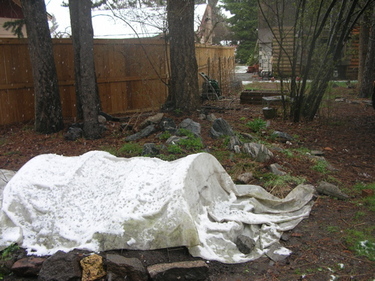
Yesterday I went about the garden taking pictures of buds and young plants, and of course of the new lettuce in a little greenhouse on the alley. Well, here’s that greenhouse today:

May_snow_2_3

Yes, the white stuff on top of the white cloth is snow. It’s after ten-thirty in the morning now, and it is just changing to rain.

Welcome to Montana.

Spring has Sprung in the Organic Greenhouse

I just got back from a trip to Minneapolis, the second week away in a month–and at planting time! No more.

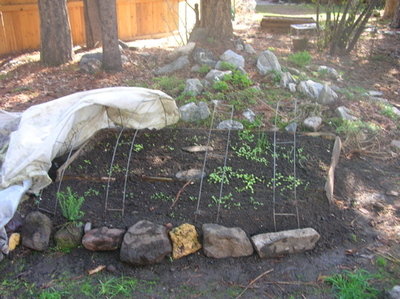
This morning I pulled the covers off the only "greenhouses" that actually made it through the winter without major damage, and here’s what I found:Alley_greenhouse_3

Lettuce_sprouts3_9 The tiny lettuce (yeah!) are in a bed on the alley that I kept protected all winter because when I did that last year, I pulled off the plastic and row-covers in the spring to find that young chard was already growing.

This year when I removed the covers I had nothing save one incipient spinach and some very dry dirt. I’m speculating (why not?) that this is one situation in which one does want to wet the bed, and that I didn’t do so sufficiently.

I’d prepped the soil last fall, so a couple of weeks ago between trips I planted alternating rows of lettuce and finger carrots. The plan (there’s actually a plan) is to harvest all this stuff in late June and plant out tomatoes that I’ve kept until then in pots.

I try to rotate crops, and it’s this bed’s turn to take on tomatoes. The big pine(s) east of it (you can see their trunks at the top of the first photo) keep it from getting sun until afternoon, but as the sun moves south at the end of summer this area gets more light, longer, than just about any other part of my garden. So the tomatoes should do okay, I think.

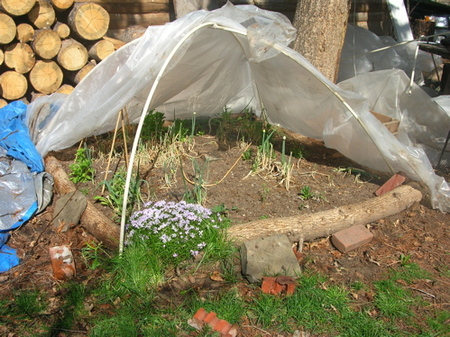
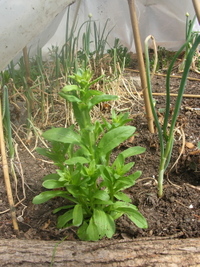
Back_yard_greenhouse_4 The square bed above is one I also kept covered all winter, more successfully. Those taller things with the white tips are leeks about to flower (I think),Unidentified_stocklike_plant_5 and there’s creeping flox already in flower, and the bushier greer things featured on the right are something that I’m not quite sure about. They resemble stock, though it’s so long since I’ve seen stock that I could be seriously mistaken. I suspect it’s a weed whose small white flowers really don’t compensate for its size.

Any bets out there?

Vindicated Again: Protecting Seeded Areas with Row Covers

All right, so it’s probably a testimony to my inexperience and hubris that I thought this my idea, but I did think it so, and it turns out it’s not, because here and there in Minneapolis where I was helping out an old friend who’d just had heart surgery were wide white swatches on lawns where newly re-seeded places had been covered with row-covers or something indistinguishable from them. (Take a breath, Kate, or as that friend used to say when we were roommates in college several decades ago, "Du calme, du calme." She was a French major.)

The row-cover idea came to me several years back when I wanted to overseed in the heat of summer. (Why then? Beats me.) The technique — combined with top-dressing and frequent watering — worked surprisingly well, so I’ve incorporated it into my lawn gardening web-site article.

In all the reading I did for that article, I never once saw mention of such a technique. (Well, maybe once, where someone suggested mulching with straw.) Yet there they were, as I say, in Minneapolis, the white rectangles on upper-class lawns, usually on slopes, so the idea may have been more to prevent seed from washing away than to provide shade and reduce the need for watering.

It’s odd; I feel vindicated, but I also feel let down, almost ripped off. That was my idea! Mine, all mine! We hates them, Precious, yesss, we does…

Organic Pest Control: Vacuum-Cleaner at the Ready

You know how these things go: a comment on my cinch bug post led to a brief conversation with my husband, me maintaining that vacuuming up bugs off the lawn is pretty odd, and he claiming that we’d actually done something similar ourselves.

"What? Vacuum up bugs–oh my god."

"Remember the roaches?"

"Agh–yes. You’re right."

"And that’s what finally got rid of them."

This isn’t strictly speaking a gardening story, but it is an organic pest-control story, so I’m going to go ahead and tell it. It took place in our San Diego days, which is a good thing, because if that many roaches had inhabited a stove in New York, neither the stove nor I would have survived the experience. Nor the vacuum cleaner, come to think of it. (I’m not afraid of bugs, but New York cockroaches are a different order of being, truly the stuff of nightmares–mine, anyway, when I was a child. It’s probably because I was the one my two squeamish sisters assigned to kill them.)

There in San Diego we noticed roaches on our stove-top from time to time–slender, half-inch long items, not New York’s lumbering giants, which are often over an inch long and half an inch wide–(and here you see one of the many ways that growing up in New York City leaves one permanently twisted: everything, for the rest of one’s life, exists in comparison with the New York version and these paler imitations are, well, paler imitations. The rule applies to fireworks, cockroaches, you name it. And you wondered what the "twisted roots" in the blog tag meant. Now you know.)

So, back in San Diego, (remember San Diego? (remember Alice’s Restaurant?) This is a story about San Diego) I got up from bed one night and turned on the kitchen light to find the stove-top aswarm with roaches. We didn’t want to spray lethal chemicals all over the surface where we cooked dinner, so we took to lying in wait for them in the dark, then flicking on the light and leaping at the stove, bug-squashers at the ready. It worked great in that we got lots of bugs every time, but there were always more. It looked as though we could go on this way forever, and we weren’t that bored with our lives.

It was Steve who proposed taking the sides off the stove. When we did–pay dirt. Or pay bugs, except that I haven’t found anyone willing to pay. They swarmed over the insulation just inside the metal sides. We could actually see the little hollows where eggs were laid.

Clearly, a couple of sponges weren’t going to do the trick. And again, I suspect it was Steve who suggested the vacuum cleaner, because he really does have a "beginner’s mind" in the Zen sense–open to new ideas and therefore infinitely creative.

There was something perversely satisfying in vacuuming up those bugs by the dozen. We practically fought over the nozzle–"That one’s going to get away!" "Let me!" "No, let me!" And then there was the other side of the stove to do.

As Steve reminded me today, after that it was just mopping up. There were a few stray roaches over the next couple of days, but really, it was over. No sprays, no traps, no powders and, thank god, no nightmares.

We get locked into set ways of thinking about things (bugs=Raid), and this rigidity cramps our style. Sure, vacuuming the lawn may seem odd–but no more so than vacuuming the inside of the stove. If we’re going to give up pesticides, we’re going to have to be creative.