Author Archives: The Manic Gardener

Post-garden post: Lettuce, anyone?

I’m going to open a restaurant.


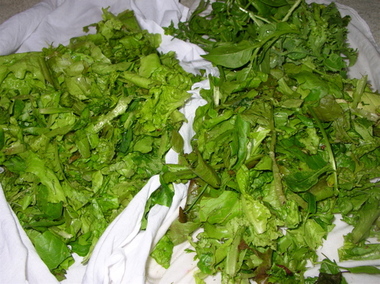
Lettuce


Customer: So—what are you serving for lunch today?
Me: Well, we have shredded lettuce, torn lettuce, lettuce julienne, and mangled lettuce.
Customer: And the soup?
Me: Lettuce puree.
Customer: Hmm.
Me: And make up your mind quick, because it’s all going to start rotting in about five minutes!

I expect an enthusiastic, upscale clientel.

Post-Garden Post: Garden? What garden?

I wrote about the storm yesterday.

Front-page headline in the local paper today: "All Hail Breaks Loose." Trees and tree branches down all over town, power out, gardens ruined, flooding downtown,  etc. etc. etc. No news yet about how local farmers fared. That’ll probably be in tomorrow’s paper.
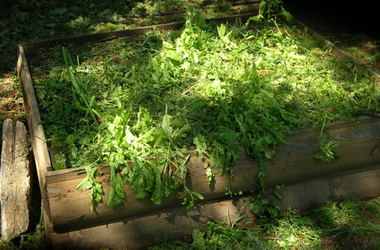
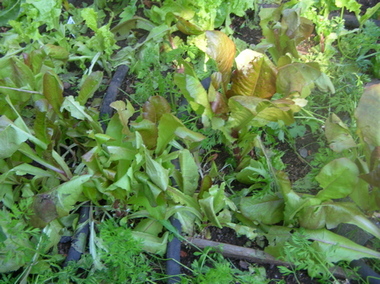
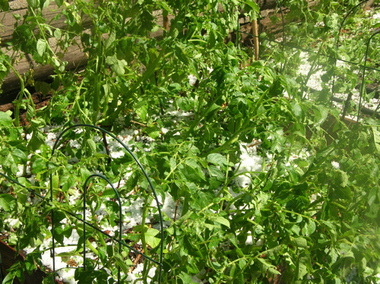
Lettuce_back_yard_after_hail_2

That green blot above was my mid-summer lettuce plot; it gets a couple of hours’ sun in the morning, then shade all day, so lettuce usually does well there right through August.

So I’m trying to get used to a world without a garden. Almost as a perverse exercise, I’m “looking on the bright side.” (Maybe I should try a limerick.)  This is not like me.

A confirmed and dedicated pessimist, I loved the poster a former dentist of mine had on his wall: it showed a damp and furious-looking kitten, with the caption, “Don’t tell ME to have a good day!” There’s a remarkable resemblance here to the meditative advice: sit with the emotion, whatever it is. I keep close to my heart the story about an African tribe that honored grief: instead of hurrying a widow through it, they provided the option of a second funeral if she felt the need a year after her husband’s death.

(Please don’t ask me which tribe; I don’t know. Which means the story could be apocryphal; most of us know so little about Africa that we could get away with almost anything by prefacing it with the words “There’s a tribe in Africa that—” I find this increasingly embarassing as I meet and become friends with more and more Africans.)

Nevertheless, here I am making lists of possible benefits to being garden-less.

There are the obvious ones–

  Think how much more time I’ll have!   

   There’s  plenty of space for fall crops!

–and the practical ones–

   I won’t have to water anything for at least a week. (Ooh–that one doesn’t really work, since there isn’t really much left to water.  Try again.)

   Good thing Steve’s brothers arrive tonight; I’ll have plenty of help with the clean-up! (Brace yourselves guys; I hope you brought your rakes.)

–the pseudo-practical ones–

   Look–the salad lettuce is pre-torn!

   There’s certainly lots of green stuff around for the compost heap!

   And it’s already mulched!

   Hey–all my trees have been trimmed–for free!

   At least I don’t have to figure out what to do with all that extra lettuce.

–the defensive ones–

 Now no one will know how late I was with my garden this year!

And then there are those that are clearly the products of a twisted mind:

   Wow, I sure seem cheerful–now we know my anti-depressant medication is working!

   The compost pile came through without a scratch!

   That trip in September? The one I almost didn’t want to go on, because it meant I’d miss the fall harvest? Well, now I won’t.

But my older son’s contribution is the best:

#1 Son: Well, it’s not everyone who gets to have the question of whether God really and truly hates them answered so clearly and definitively. No more wondering! No more questioning! That knowledge is priceless. You’re not writing that down, are you?

Me: No, never.

#1 Son: Well, you should. It’s better than anything you could come up with!

Ain’t it the truth. As my mother-in-law used to say, You gotta laugh.

I Used to Have a Garden, or, So who needs lettuce?

Lettuce_after_hail_4_2  

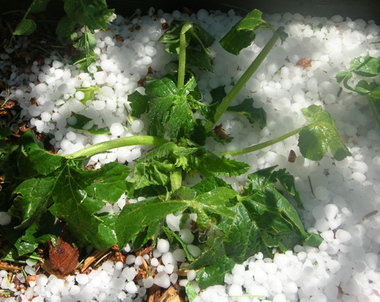
Well, shit. Hail for the second time in a week. The first time shredded my lettuce bed pretty badly, as you can see below.

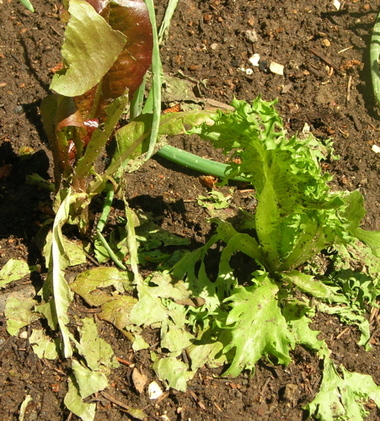
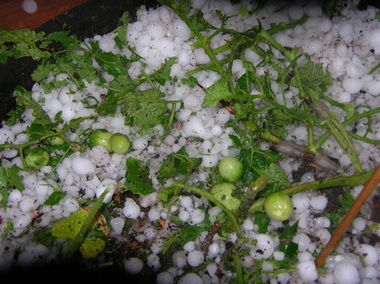
Lettuce_after_hail_3 This one about ruined the young lettuce I’d planted for family across the alley who let me use gardening space in their yard; those greenish smears used to be lettuce plants.Marsinko_lettuce_after_hail_2 Things look almost as bad in the lettuce bed next door, where five college guys also let me use space. (This is my plan for world hegemony: yard by yard, I advance.)

I did wrap a row-cover over one tomato and young squash in a barrel, and they fared better under the weight than others did with the slash and freeze of the hail itself. This young crookneck squash took a real beating, though, Squash_after_hail_4 as did the potatoes. 

Potato_patch_after_hail_2

The whole thing was over in five or ten minutes. The temperature plumetted, from somewhere in the high eighties or above (it’s been in the mid-nineties recently)  to the sixties or lower, then swung abuptly back up as the  cloud passed away and the sun returned.  The neighbor’s picnic table, heated in the sun, then doused and cooled, and warmed again, created its own little cloud:Steaming_picnic_table_after_hail

When it was over, we had flooding in the cellar and a leak in the dining room. That was two hours ago.

Oh god, it’s starting again. It’s almost six-thirty, darker than it usually gets till nearly ten, and it sounds as if the house is under seige. What happened to good old-fashioned thunderstorms with RAIN? Some of these hailstones are in clusters; some are an inch in diameter.

The tomato I saved this afternoon has been flattened; the delphinium in the circle garden, just about to bloom, have disappeared into the earth. Leaves from the golden current just outside the window are plastered on the screen, and the branches, lush even after the last onslaught, hang bare and tattered.

Eh–I never really wanted to garden, anyway.

I keep remembering the summer in Laura Ingalls Wilder’s last book, The First Four Years, when her husband Almonzo decided to wait one more day before harvesting the oats. A hail storm came through that afternoon, ruining the crop. There are probably people only a couple of miles away from me for whom this is not an inconvenience, but a tragedy. I am one of the lucky ones.

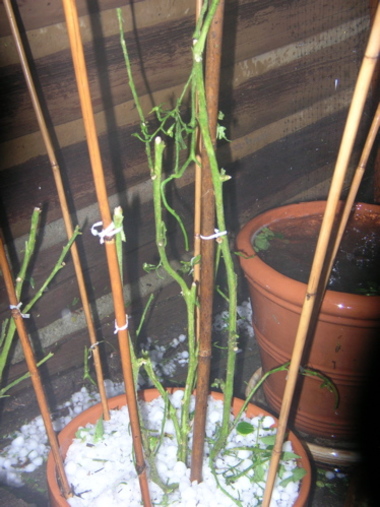
Okay, I just went out to assess the damage, and it’s almost total. Here’s the tomato I managed to save this afternoon:Tomato_small_after_hail

Here’s another, much bigger one:Tomato_tall

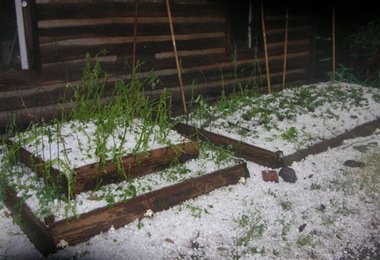
And here is the main garden plot:After_the_hail_3

The smaller box in front is the one that held potatoes this afternoon. Also peas. As for the back plot–wow. The peas were so lush, the beans behind them coming along nicely–all gone.

My husband calculates that if there was a centimeter of hail, (it’s drifted inches deep in places) then actually a ton of ice fell out of the sky onto our lot. Is this what the hand of God feels like?

Tell me your disaster stories, so I don’t have time to feel sorry for myself.

Continue reading

Fertilizing the Earth to Death: Thomas Hager on Nitrogen

Got an e-mail recently from a very interesting fellow who’s just written a book about the chemistry and ecology of synthetic nitrogen fertilizers, and if you haven’t had your fix of ecological chills recently, keep reading. The e-mail arrived in the midst of the Sock Wars, so I scrutinized it with more than ordinary vigilance, as if it might blow up in my face (revealing another face under a large hat, laughing madly), or as if the virus it harbored might bloom suddenly into sock-tossing flowers.

Having eventually decided (using a fool-proof method of one part deduction and eight parts pure guess-work) that the e-mail was legit, I followed the link provided and found myself reading a long and compelling passage about the unintended and dangerous consequences of nitrogen fixation, the basis for nitrogen fertilizers.

The fixation process, which takes nitrogen from the atmosphere (where it makes up 70% of the air we breathe) and incorporates it into compounds, has doubled the amount of nitrogen in and on the earth. When it’s applied to land as fertilizer, some of it is released as gas – and while some of that gas is the same harmless, inert N2 that we breathe all the time, some is now bonded with oxygen, forming the green-house gas nitrous oxide.

Continue reading

Monday Muse: Wayward Wayman Again

For those of you who thought that Wayman’s Picketing Supermarkets was way too political or preachy, I thought I’d share this one, which has nothing to do with gardening, but everything to do the importance of a light touch, and the price of politics out of place. I just love a guy who can laugh at himself.

Wayman in Love

At last Wayman gets the girl into bed.
He is locked in one of those embraces
so passionate his left arm is asleep
when suddenly he is bumped in the back.
"Excuse me," a voice mutters, thick with German.
Wayman and the girl sit up astounded
As a furry gentleman in boots and a frock coat
Climbs in under the covers.

"My name is Doktor Marx," the intruder announces
settling his neck comfortably on the pillow.
"I am here to consider for you the cost of a kiss."
He pulls out a notepad. "Let us see now,
we have the price of the mattress, the room must be rented,
your time off work, groceries for two,
medical fees in case of accidents."

"Look," Wayman says, "couldn’t we do this later?"
The philosopher sighs, and continues: "You are affected too, Miss.
If you are not working, you are going to resent
your dependent position. This will influence
I assure you, your most intimate moments."

"Doctor, please," Wayman says. "All we want is to be left alone."
But another beard, more nattily dressed, is also getting into the bed.
There is a shifting and heaving of bodies
as everyone wriggles out room for themselves.
"I want you to meet a friend from Vienna," Marx says. "This is Doktor Freud."

The newcomer straightens his glasses, peers at Wayman and the girl.
"I can see," he begins,"that you two have problems?"

           Tom Wayman