Author Archives: The Manic Gardener

Musings on the Meanings of Doors

In Which It Is Proven that you may get the Person out of the English Department, but you cannot get the English Department out of the Person

Warning: The following entry elides (or descends, depending on your point of view) into vaguely philosophical meanderings, touches on autobiographical events of no relevance to gardening, and alludes to several books, including Moby Dick and Winnie the Pooh.

Back in October, I spent approximately half-an-hour one afternoon sitting on my back step in the watery sun, staring at a piece of plastic.

Be specific, said my English teacher’s mind. What kind of plastic? But I couldn’t be specific, because I didn’t know. Polyurethane? Vinyl? Words, just words. It doesn’t matter. Get on with it.

It’s a sheet of “clear” flexible plastic, and I was trying to figure out how to make a door to the greenhouse my husband just built of it. At the moment, I was getting in and out by removing the brick that holds down one “wall” of the structure and sliding between the house wall and the plastic one. It’s not a very neat or elegant means of ingress or egress, but the half hour before the one I spent staring, I spent going in and going out. I went in to check on the tomatoes the structure was protecting (they were doing fine), and out because I was done looking, and in to look again, and out to get a chair, and in with the chair, and out again with the chair, and in to move one of the barrels because there wasn’t room for the chair, and back in with the chair, back out for my coffee, and in with the coffee, and out for my book, and in with the book—you get the idea. There was always a reason to go in or to go out, but really I was going in and going out merely for the pleasure of doing so, like Eeyore, who was so taken by the house built for him by Pooh and Piglet because he had been complaining about how “it’s not so warm in my meadow at two in the morning,” that when it was done, he went in and out, in and out.

Why? Because to do so defines the inness of the inside, to pass between the two places defines their difference, and it is that difference that defines each place, giving each its identity. (Thank you, Ferdinand de Saussure oh father of modern linguistics (who argued that no letter or sound had absolute value; each was defined only by its relationship with, its difference from, other sounds and letters, as the inside of the greenhouse is defined only by it’s difference from the outside) and to Jacques Derrida oh great deconstructionist master (who would spell it "différance," to illustrate the difference between speech and writing, for as every English grad student and most majors these days knows, "différence" and "différance" sound the same in French, despite their graphological divergence))
not to mention Herman Melville

And it was Melville who put it best, I swear, (so betraying a preference for literature over criticism that even grad school couldn’t beat out of me) for, when Queequeg is in bed with his "clean, comely looking cannibal" early in Moby Dick, warm and comfortable despite–indeed because of–his still-chilly nose, Melville says that “truly to enjoy bodily warmth, some small part of you must be cold, for there is no quality in this world that is not what it is merely by contrast. Nothing exists in itself.” How can you be clearer about having a house than by stepping outside of it to experience its absence? How can I better enjoy my new greenhouse, or prove to myself its existence, than by passing through the wall that creates it?

Wow. As Garrison Keillor has proven, once an English major, always an English major, but apparently it’s even more true of English graduate students. I haven’t been one for decades, but as the paragraph above shows, the stuff I absorbed there has a truly insidious grip on my language, my thinking (and what’s the relation between those two, hmm? Does the first in fact shape the second, à la Saussure, or can we think independently of the words we use?) Oh help. I really need that garden. Not to mention the door.

Tomato Harvest in December

A few days before Christmas I harvested my tomatoes. This is late anywhere in the northern hemisphere, but here in Montana it’s absurd. I wish I could claim credit of some sort (Breakthrough! Cold-Busting Tomato Developed! Local gardening Gardner touts cold-tolerant tomato.) But no; the late date just testifies to my late start last spring.

I did my picking in the basement, where I’d hung my vines a couple of months back, upside down and full of green tomatoes–over eighty on my finest specimen, even after I’d plucked those damaged by frost. These were soft, and a darker green than the healthy ones. I’d done everything a good tomato-mother can do to protect the plants from frost–swaddled some plants, put hoops and  plastic over others, erected full-fledged greenhouses around others–but despite the protective layers, some suffered.

So at last I conceded, pulled the plants, and hung them from the big nails in the basement beams near, not so conveniently, the washing machine and the table where I dry sweaters in winter and plant seedlings come spring. Somehow, picking in the basement lacks romance, and the crumbling leaves sticking to my sweater and drifting to the floor couldn’t compete with flexible foliage. Still, there’s something satisfying about picking tomato after ripe tomato and piling them all in a bowl in the kitchen.

As the photo shows, I also picked plenty of green tomatoes, and these are unlikely ever to ripen no matter how much I swaddle and coddle them. I’ve made green-tomato chutney before, so this year I may try green-tomato pie. As for the ripe ones–they’re probably not of salad quality but should make good sauce.

Tom_crop_fr

The photo is pretty true to color, and you can see that while some of the tomatoes are the classic slightly orange of  "tomato red," several lack that orange tint. These are my heirlooms, and the pity is that I don’t know the variety, since I just planted a few seeds from a package of mixed heirloom seeds. It is true though, as heirloom aficionados insist, that these tomatoes have an intensity that puts others to shame. Interesting that that intense flavor is matched by this intense color.

The Accidental Interview, or The Bare Beginnings of a Blog

All dialogue is approximate, and I apologize in advance to those whom I accidentally misquote and otherwise misrepresent.

So there I am at what I think of as my local organic gardening outlet Planet Natural, waiting to pay for my non-toxic weed-killer and my hemp twine, and just as the young woman behind the counter finishes with some sort of bookwork, a guy with his shirt hanging out over his shorts comes clattering down the stairs and shoves a piece of paper under her nose.

“What do you think?”

She reads, shakes her head, and hands it back.  “Uh-uh.”

“Why?”

She’s already scooped up the papers she’d been working on, but pauses a moment to consider before filing the folder and making her answer:  “It’s too–”

And I wish I could remember exactly what she said then.  It wasn’t “pro-forma,” but it might have been “formulaic;” it wasn’t as predictable as “predictable,” or as dull as “dull,” and I doubt, having heard her pithy style since, that it was as wordy as “sounds like everyone else,” but that’s what it meant.  “Sounds like a toothpaste ad” gets the flavor right.

“Huh,” says the guy, and weaving between tables covered with organic pesticides and fertilizers, he marches the paper across the big, wooden-walled room to another young woman (it would be a while before I got them sorted out) calling, “What do you think, Shannon?”

There’s a pause while Shannon looks at the paper.  I consider suggesting that the woman behind the counter actually ring up my intended purchases, but she’s watching Shannon read.  I’m not in that much of a hurry, and I’m curious to see what Shannon thinks, so I watch too.

“Like Katrina said.  It’s just–not original.”

“Huh,” says the guy again.  “Well, what about the second one?”  He’s already halfway back through the organic obstacle course of round wooden tables to Katrina.

“I dunno, I just looked at the first one.”

She’s reaching for the paper–my potential purchases are still on the counter between us–when I lose it.

“I can’t stand this,” I announce, “let me see.”  By way of excuse, I add, “I’m a writer and an editor.”

The guy looks at me with more interest and less animosity than might be expected under the circumstances, and swipes the paper back from Katrina, who has had time to announce that the second one was better.  Over the next five minutes, I learn that the guy is Eric, owner of the business, that the short paragraphs on the paper are drafts for the key description that will go up on the business’s web-site, and that Eric is in need of writers for that web-site and others.  He, in turn, learns that I, too, prefer the second one.  He also learns my name.

“Hey,” he yells, vastly amused, “her name is Gardner!”

We agree to talk more, but not now, I say; I’m already late for an appointment.

In the end, I leave with the paper and with my twine and weed killer, but without having paid for them; because I’m late and he held me up, Eric lets me have them on credit.

He knows I’ll be back.

Digging in the Dirt

So, to briefly recap my first post, there are lots of trees in our yard. Way too many for good gardening. To make things even more fun, the dirt here (it doesn’t deserve the name of ‘soil’) got itself mixed up with cement at some point, and in its desire to emulate that substance it resists tools with a stubbornness I might admire if I had any energy left over after a round of ‘digging’ that more closely resembles hacking away at, you got it, cement. In the back by the alley, we can abandon the metaphor, for the dirt there quite literally got mixed up with cement. Dig there (if you can) and you’ll find chunks and chips of cement. Also bricks, bits of bricks, and lots and lots of rocks. According to my ninety-year-old neighbor to the north, who’s lived there since the fifties when she and her husband bought the two lots north of ours from the then-owner of our house, a brick-making facility used to be on our block. The evidence bears her out.

That alley strip is so inhospitable that we decided to go for raised beds, which my husband built for me our second year here. Our first year we spent trying to fix up the house to the point where some bank somewhere would be willing to issue a mortgage on it, which meant taking on — or off — the shag carpeting from the seventies and below that linoleum from the thirties when the original log cabin was built, not to mention moving the kitchen, building a new floor in the addition, refinishing the finally exposed fir floors in the old part of the house, putting in new windows, repainting everything, and having the roof redone (the only thing we hired out) to fix the leaks under which the previous owner, in all other ways a great guy, had been parking buckets for ten years (thank god this was Montana, with its super-dry climate, or there’d have been rot to contend with not just a roof to replace). Talk about your fixer-upper.

Not much gardening got done that year, but by our second summer in the house we had the mortgage, and the gardening itch had to be scratched. Since only the alley (as amply demonstrated in the earlier entry) gets several continuous hours of sunlight, the raised beds were a priority. Steve used leftovers of the log siding that covers the seventies addition to the house. (The siding was a great choice aesthetically, as the new part of the house blends pretty well with the original log cabin, but as we have learned to our sorrow, it doesn’t hold a candle to real logs as an insulator.)

To fill the beds we had to buy soil, and in a misguided fit of economy I went for the cheapest earth advertised. The term "sandy loam" had been used in the ad; I probably could have won a suit for false advertising.& A friend (a lawyer, actually) suggested I return it, but in the grip of the encouraging claim in a gardening book that any soil could be made workable, I didn’t.

Over the five summers since, I’ve dug tons (and that may almost be true) of compost and peat moss and gypsum ("works like millions of tiny crowbars!") and crushed bricks ("great for clay soils!") into those plots, with the result that they are apparently earthworm heaven, but they still harden over the season to the point where it’s not only impossible to pull up carrots, it damn near impossible to dig them up.

My latest strategy is sand. Unfortunately, the situation’s so bad that digging sand in coats dirt clods while leaving them intact. There are clumps of clay in that dirt so dense that they don’t crumble when pressed, they just squash; they deform, like clay. The only way to break them up, I’ve found, is to rub them on a stone with a handful of sand. Now there’s a way to spend an afternoon.

So now you know my dream: to be able to pull up carrots. To that end, I will now go outside and squash a little more sand into a few more clods of clay.

Tales of an Organic Gardner: My little space under the big sky

We did not choose this house for its gardening possibilities. We are not that crazy, despite what our children say. We chose it, I suspect, because it was built of logs and surrounded by trees and made us feel as though we really were living in Montana.

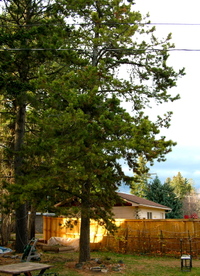
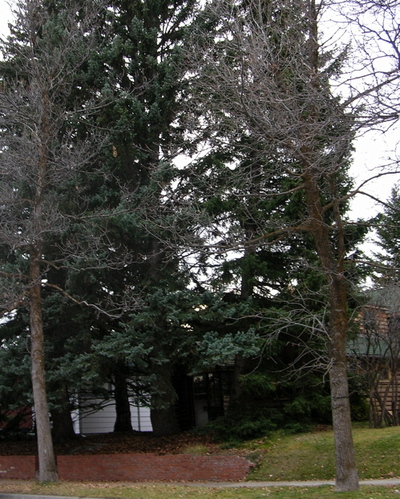
Of course, as you scan the photo below you’re probably thinking, "What house?" Which is precisely the point. Long-time residents of Bozeman have had to be talked in to our front steps via cell-phone, because they couldn’t see the house for the trees. (That white clapboard in the lower left? That’s the neighbor’s house.)

Front_w_2The West’s contribution to my "garden" is two clumps of conifers, one fore and one aft, which do wonders for ambiance but nothing for the vegetables. Don’t get me wrong — they’re great trees and I love them: love the smell, and the sound, and the sense of forest they bring to our home — but they’re hell on gardening.

So much so that I’ve variously begged and bullied until my husband has agreed to take down several of the smaller ones: a sickly cedar and two young but bushy items whose identity remains unknown, though ash is on the suspect list. The rest of the family (the afore-mentioned husband and our two sons) look on such cullings with grave disapproval, and I am persona non gratis after each tree-attack. (Arthritis keeps me out of the direct tree-cutting business, to their relief no doubt, and restricts my role to nagging, to their regret.) After one particularly active tree-cutting season, my older son, seeing me get ready to go outside, would ask acerbically, "Going to cut down a tree?"

Given my ostracization, it was a relief that the telephone company took out one of the trees. For that one at least, I bear no responsibility.

Even after all this pruning, there is literally no place on our lot that gets full sun. It’s not a big lot to begin with. The front "yard", on the east side of the house, is a non-starter, being occupied by four sixty-foot tall spruce trees, and therefore by nothing else save a lot of pine needles.

The north is a narrow strip of grass, neither big nor sunny enough to do much. Let’s not go there.

Bk_yd_5 The west side of the house actually has a few square feet of ill-tended scrappy lawn, (with a pine in the middle, naturally) a gradually disintegrating log garage (with another large pine by it), and more trees, all conifers now that I’ve had my way with the other ash, save for a non-bearing choke cherry. (Too much shade, perhaps?).

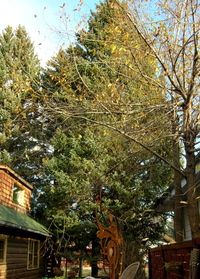
To the south, the front-yard spruce grove continues its hegemony, adding another great tree to its number. (As a result, the house stays marvelously cool in summer, and remarkably cold in winter.) Then there’s the cement patio, where I grow tomatoes in a row of barrels up against the house. Of course, they’re shaded by a tree (deciduous for once) that grows just over the fence by the neighbor’s house.

The projecting roof of that house actually shoves the tree towards us, creating an exemplary illustration of the silver-lining theory (every silver lining requires a cloud), for it (the tree, not the theory) provides welcomeS_spruce_4_6 patio shade in summer but equally unwelcome shade for my container plants in summer and fall. Round October it (the tree) seems to be deciduous only in theory (a different theory), or at least dedicated to the proposition that all trees, not just Russian olives, should hang onto their leaves all year, for fall is what they don’t and don’t and don’t, though as you can see in the photo to the right taken on November 11th, they finally do. All along the south fence our neighbor’s yard offers a steady supply of shade for our lawn and for my peas and lettuce: a chokecherry that does bear entwined in something big and dead, a miniature plum, a crab apple, another ash, and then their share of conifers.

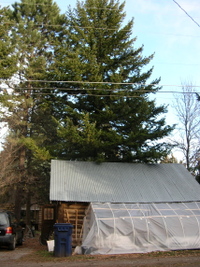
Alley_tr_3_4 This leaves the strip along the alley, beyond the garage. Of course, because of the garage, the tree over it, the trees in our neighbor’s yard, and the pines in ours, that strip gets no sun until between twelve and two, depending on the season, and thanks to the tall lilac hedge across the alley (not to mention the two-storey garage) the sun lasts until between five and six. My alley plots therefore get between three and six hours of full sun — not what’s generally recommended for squash or eggplant.

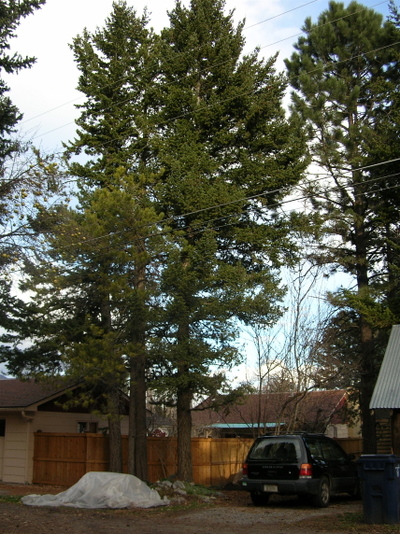
That’s the situation: a small, urban lot (in Montana!) with eight major conifers on it, a bunch of other trees on and around, and a die-hard glutton-for-punishment ex-New Yorker trying to raise a few organic vegetables on what’s left.

So if this post seems to be increasingly hung-over, or over-hung, by large, looming trees; if the text seems in danger of disappearing into a forest of photographs, well, all I can say is, Yup.

From our yard, it’s not such a big sky at all.

–Kate Gardner

Nw_trees_3_7